Tuesday, March 16, 2010

A week in Puri

All the VSO India volunteers + representatives from their partner NGOs were invited to attend an annual conference.  The last time I joined a VSO conference I had to travel all the way to Delhi but this one was held in Puri in Orissa.  The number of VSO volunteers placed in Orissa has increased significantly since I arrived here last year so it seemed a good state to choose to minimise the number of volunteers having to travel too far.  We were lucky that the chosen venue was a very nice seaside town with interesting places to visit nearby but there were probably other constraints in that there had to be a hotel big enough to host 50 volunteers + 50 partners and appropriate conference facilities.  Some of the volunteers may have felt that it was a long way to have to travel but at least I didn't have too long a journey this time.  

It was really nice to have the opportunity to meet up with so many other people and find out more about what's happening in other parts of the country.  Volunteers based in Delhi have the advantage of seeing colleagues who are passing through the city which is the home of VSO India Programme Office, they.  The Delhi vols get to meet the new volunteers arriving and to say goodbye to the people leaving at the end of their placement but those of out in the more remote parts of India rarely see other volunteers so gatherings like that in Puri are really valuable to us, helping to remind us that we are not alone.  Places like Koraput have little in the way of social life or other outsiders and apart from trying to get to know our neighbours with our limited ability to communicate in each other's languages and meeting up with any other colleagues nearby we don't have the same opportunities to meet other people.  The conference went the way of most conferences, some bits inspiring and some less so but overall, it was a good week for me, giving me the chance to catch up with colleagues, meet some of the other NGOs and hear more about VSO India plans for the year.  

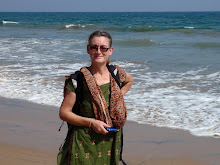
Orissa is famous for its fish and seafood but Koraput is too far from the sea and too poor to get any of these delicacies so I made the most of the local catch while I was there as I love seafood along with other things hard to find in rural areas - muesli for example!  Puri is a coastal resort with what looks like a lovely beach with waves rolling in from the Bay of Bengal.  I got up early in the mornings to go for walks with my camera while the light was good and not too bright.  The beach was full of people playing cricket and fishermen either pulling their boats into or out of the water or sorting out their nets.   Some friendly fishermen spotted Jim and I taking photos of them coiling their nets and insisted that we posed with them and their nets.  I suspect that Jim has a similar photo of me 'helping' with the nets. I did however have to watch my step when walking north along the shore as there is a fishing village at the top of the beach without sanitation.  Given the location the appropriate solution is for the people to use the littoral (the area between high and low water) as their latrine so that the water cleans the area twice a day and disperses the debris into a dilute state.  Sensible but not so great for paddling through the waves.  The pigs seemed to be enjoy it though.  I love swimming in the sea but decided not to swim on that beach but later in the day the sea was full of life and people having fun.  I managed to pick up some rather unpleasant gastro-intestinal bug that afflicted a good many of us from the conference.  I suspect that we all fell prey to a virus as we gradually went down with the bug and didn't all fall ill at the same time.

Puri seems to be a popular place for backpackers and felt a bit like it should be on the hippy trail.  The conference was held in the only hotel big enough for the numbers but I added a few days onto the conference to have a break from work and the delights of Koraput.  I struck lucky with the hotel I chose for my extra days, a delightful place called the Z Hotel, apparently the former home of a maharajah with wonderfully big, clean, airy rooms and a communal balcony area with breeze blowing in and the sound of the sea just a few hundred metres away.  We met some really interesting people staying there, it seemed to be one of the places that attracts some eccentrics as well as the more ordinary like me.  

I took a day trip with my volunteer friend Sheila to Konark a few kilometres north of Puri to see the Sun Temple, a Unesco World Heritage site.  This was fascinating with some extraordinary stone carvings and was built in the form a chariot for the sun god Surya with 12  pairs of wheels and pulled by 7 pairs of horses.  Much of the stone has crumbled  away through erosion of other damage but it is still a tremendous piece of architecture.  What I hadn't realised until I saw the place and heard the guide's descriptions was that many of the sculptures appear to be inspired by the Karma Sutra.  <a href="http://en.wikipedia.org/wiki/Konark_Sun_Temple"> Sun Temple <\a>.  

Monday, March 1, 2010

Festival of Colours

I've just emerged from one of the maddest and most colourful days of my life.  Today, Koraput celebrated Holi, the festival of colours.  I've tried to find out what Holi is all about.  Some say it is to celebrate the change from winter to spring, some say it's the triumph of good over evil, some refer to the legend of Prahalad and Holika.  It probably has a combination of roots and is celebrated in many parts of India by people smearing each other with paint and throwing coloured powder and dye over anyone and anything in their path.

Whatever the reason, it has been a good excuse to relax and have fun for many people in Koraput.  I went out for the day with my new friend Anne Heslop, a professional photograper based in London who funds various small projects here in Orissa (Anne Heslop).  Annie's charity, Goats and Hopes has a number projects including the funding of 2 schools near the town of Koraput.  These schools were built and run for a few years by the Save the Children Fund.  When they withdrew their funding, the schools were threatened with closure until Anne managed to find sponsors to help her fund the continued running of the schools.  Annie also raises funds for mosquito nets and malaria education, Koraput being a high risk area (30% of India's malaria cases are here in Orissa and of those, 90% of those cases are the most dangerous sort, cerebral malaria) and she has projects running to supply solar lights to remote villages without electricity.  Anne spends a few weeks in Koraput each year visiting her projects and doing photography to help with her fundraising.  I was lucky enough to meet her last week and we soon made friends.

Annie has been videoing children at the schools to create a film to send to her sponsors and to try to attract new sponsors and asked me if I would like to spend the day with her while she worked at the schools.   Little did I know what people mean when they talk about celebrating Holi.

Saturday, February 27, 2010

A village near Lamtaput in Koraput district, Odisha


The main street
The baby didn't know what to make of this strange-looking white person wielding a large contraption in front of their face.  Pretty scary I think


This is what I like to see, sharing resources


The children all seem to do work as soon as they are strong enough.  Sometimes it's looking after their younger siblings, sometimes it's helping with the family chores, sometimes it's helping their parents grow their food, sometimes it's going out to earn money to help the family survive.

But they still manage to have fun


Jackfruits swelling on the tree and a mango tree in full bloom.  I can't wait for the mango harvest!

Thursday, February 25, 2010

Some more paddy fields

I found out that a by-product of the paddy fields is small fish that live in the irrigated land.  No fish in these photos but to my western eyes it was an impressive sight.  The thing that surprised me was the sound of rushing water as the river drained and cascaded slowly down the land
 The paddy is sown in nursery fields after harvest and the seedling transferred by hand into the main paddy fields (padia or bila).  This seems to achieve a better rate of germination and seedling survival than scattering and although the work looks backbreaking to my pandered western eyes, provides much needed work and wages for the community.
 The cranes seem to like the irrigated fields.  Maybe they're fishing as well?

Wednesday, February 24, 2010

A lovely garden

I had another trip out to the field at the weekend, this time to an area close to the Machkund Dam on the border with Andhra Pradesh.  The Machkund river was dammed in the late 1940's as part of a large hydro-electricity scheme.  The project resulted in the displacement of many adivasi villages and families and also disrupted the irrigation that had been developed for the cultivation of paddy.

The local communities are working hard to make a sustainable living from their land with many self-help groups (SHGs) set up to facilitate the process.  We were out with a colleague from another NGO talking to the community about the potential of setting up cooperatives to manage the cashew cultivation, harvest and marketing.  Cashew is an important crop in this area, there are cashew plantations growing in the dry soil, many of them managed by big corporations which may not always get the best deal for the adivasi community. 

I was taken on a tour through a thriving vegetable garden cultivated by a SHG.  It put my gardening efforts to shame. To my inexpert eye, the soil here looks dry, lacking in organic matter and difficult to make productive.  I clearly know nothing about growing vegetables.


These tomatoes may not look as visually impressive as the ones we see in our supermarkets at home but the flavour is wonderful and they cost anything between 2 and 15 rupees in the markets here, depending on demand and the weather conditions.
The potatoes are also very tasty but like growers the world over, there are pests that also make their attack on the crop, in this case rats


Carrying some of the day's harvest into the village

Sunday, February 21, 2010

A glimpse of life in the village of Khajuripadar


I met some lovely people in Khajuripadar.  Most of them don't even speak Oriya but their own tribal dialect although most will understand Oriya.  My pitiful attempts at speaking Oriya elicited much laughter and teasing but we managed to communicate somehow and I was made to feel very welcome.  The project coordinators can all speak pretty good English and many of their team members manage a few English words but one afternoon I was left to fend for myself for the afternoon while the teams went out to do some field work.  I sat down in the shade with my Oriya book to try to do some homework but was soon made to get some exercise with a cricket bat.  We discovered that I seem to be able to hit a ball (usually onto a thatched roof or into a neighbours yard) but am without the capacity to catch a ball.  Never mind, at least I managed to hit the ball.
This is the house where I slept each night.  The room was sparse but clean.  The floors are all bare, hard packed soil but very solid and kept well brushed.  I did have a bed but the lack of mattress made me appreciate my own bed all the more when I got back to Koraput.  I felt very guilty when I found that this room is usually used by some of the team members who had vacated it to give me a private room.  I did share it with a bat that kept flapping around one night.


These pictures make the place look idyllic.  It is very beautiful and peaceful, a remarkably relaxing place to stay.  However, we must not forget what it must be like living in such a remote place when you are sick, have no money to travel or pay for medicines, your children can't get to school, the only water supply is a single pump shared by all, there is one toilet in the village and then there's the monsoon which will turn those hard, compacted soil surfaces into mud.

This lady, who had the loveliest, sweetest smile I've seen for a long time spent hours sweeping the village clean every day.  She put me to shame, I will try never to moan about doing the housework again.